Want more posts like this in your life? Join the Tiny Buddha list for daily or weekly insights.
“The greatest thing in the world is to know how to belong to oneself.” ~Michel de Montaigne
Some people fear spiders. Some fear public speaking.
My biggest fear? That my plus-one will always be my own reflection.
More and more people are finding themselves in the single life—not because they joyfully signed up for it, but because they’ve quietly resigned themselves to it. Being alone forever is one of the worst things most people can imagine. And yet, nobody’s talking about it.
I have no interest in bashing men—I love them. And I’m not here to shame relationships—I’d still love to experience conscious partnership or marriage one day. But what I am here for is giving a voice to the other side: the reality of singlehood. A reality that has been shamed, underrepresented, and spoken over for lifetimes.
Yes, humans of all kinds fear being single. I happen to live it in the skin of a woman, but the fear itself is cultural, primal, and deeply conditioned.
Not a Witch, Not a Spinster, Not a Divorcee
The stigma of singlehood is sticky and insidious. It convinces people to stay in relationships they’ve outgrown because it’s “better than the alternative.” It whispers that you’re not enough without a partner. And the biggest problem? We have so few role models of people living single, fulfilled lives.
I’m not a witch. I’m not a spinster. And I’m not divorced.
Funny story—when I was once applying for a work visa abroad, the form asked me to declare my relationship status. The options? Married. Divorced. Spinster. That was it. Guess which box I had to begrudgingly tick? I still laugh about it, but it says everything: if you’re not partnered, you must be a problem to categorize.
It’s in Our Bones
The roots of this run deep. For most of history, women’s survival was directly tied to men—financially, socially, legally. That dependency shaped generations of cultural messaging we all still carry in our bones, regardless of gender. We’ve been taught that wholeness comes from someone else.
For anyone who has spent long stretches of life single, there’s a peculiar kind of grief that shadows us, not for something lost, but for something never felt. We grieve the idea of intimacy we were promised, the mythical “other half” we were told to need. It’s less about absence and more about a haunting—mourning the story we’ve been handed rather than our own lived truth.
Maybe Disney messed us up. Maybe it was Jerry Maguire’s iconic “you complete me.” But the truth is, our obsession with relationships is far older than pop culture. It’s centuries old. And it’s led so many of us on a quest for “another” long before we’ve gone on the quest for ourselves.
And now? The dating industry has taken that centuries-old conditioning and turned it into a multi-million-dollar business model.
It shows up in quiet moments, like the friend fresh out of a twenty-year relationship who whispers, “What if I never find someone else?” as if that’s the worst fate imaginable.
Legacy, Good Girl, and the Seventh-Grade Soothsayer
We may have moved beyond needing a partner for a bank account or a roof over our heads, but inside many of us lives a whole cast of characters who haven’t gotten the memo.
In my case, they look like this:
- The legacy-burdened one—the part that still believes worth is sealed only once I’m chosen.
- The good girl, who doesn’t want to disappoint the family, who smiles politely when someone says, “You’ll find someone soon.”
- The people pleaser who wonders if they should tone themselves down to be “more dateable.”
- And the inner child who still remembers the sting of being told in seventh grade, “You’ll never have a boyfriend” and worries, even now, that maybe it was a prophecy.
Different faces. Same message: You’re not enough on your own.
Swiping Right on Your Insecurities
The modern dating industry has taken this centuries-old programming and turned it into a goldmine. Apps, relationship coaches, matchmaking services, and self-help books all thrive on making your relationship status yet another problem to be solved.
Not long ago, I was on a twenty-four-hour road trip listening to yet another relationship self-help book. This one at least was about “becoming the one,” but even then, the end goal was still to get the partner. Where are the books about deepening your relationship with yourself, not as a prelude to love, but simply to live your damn best life?
And can we please stop acting like every contrived meeting arranged on an app is a “date”? We used to meet organically in coffee shops or elevators; now we swipe because we’re too afraid to make eye contact in real life.
The funniest part? Friends in relationships often get more excited about my first meets than I do—as if I’m finally about to be rescued from the great tragedy of my singlehood.
Love, Yes; Panic, No
Biology matters. We are wired for connection. We crave intimacy and belonging. This is not about pretending otherwise.
What I’m talking about here is the fear of being single—the panic that drives bad decisions, keeps us in misaligned relationships, and has an entire industry profiting off our insecurities.
Rather than pouring all that longing into loving and being loved by one person, we could simply be… loving. Period. Creating a more compassionate relationship with ourselves. Spreading kindness. Offering to everyone the kind of love that heals the world. Because when we’re busy running from the fear that something is inherently wrong with us, we miss our greatest capacity—to love, in every direction.
The Gift of Being Unpartnered
Here’s the thing nobody tells you: I can literally do anything I want.
If there are socks on the floor, they’re mine.
If the yogurt is gone, I ate it.
I can book a trip on a whim, sleep diagonally, and never negotiate over the thermostat. Netflix isn’t infiltrated with someone else’s questionable taste, and no one wakes me up in my sleep—except my dog.
If I’m honest, my unfiltered fear about being single forever isn’t loneliness. It’s choking on a piece of toast and no one finding me. Or never experiencing the kind of deep intimacy and vulnerability I still hope for.
But here’s the freedom side: I’ve gotten to know myself in a way I never could have if I’d always been in a relationship. I’ve formed an identity that’s mine—unshaped by a partner’s wants or habits. And I want anyone living single to know this is not a consolation prize. This is one valid, powerful way to live. You haven’t failed. Your worth is not measured in anniversaries.
For me, soulmates show up in friendship as much as romance. My best friend and I joke we’ll probably live side by side when we’re old. Deep connection isn’t confined to coupledom, and that truth is liberating.
Single By Trust, Not Default
Seeing singlehood as a radical act of self-trust in a culture obsessed with coupling is… well, radical. And honestly, it’s 2025. We’ve accepted gender fluidity. Sexuality can be expressed on any spectrum you choose. So why are we still categorizing people by relationship status? Why is this still the metric we use to size up someone’s life?
And this isn’t about some performative empowerment—people determined to prove they’re so strong, so independent, so “I don’t need anyone.” That’s still a posture that defines itself in relation to others. What I’m talking about is living fully for yourself, without apology, without your relationship status being a headline of your life.
So maybe the real question isn’t “Will I end up alone?” but “Who can I be if I’m not waiting to be chosen?”
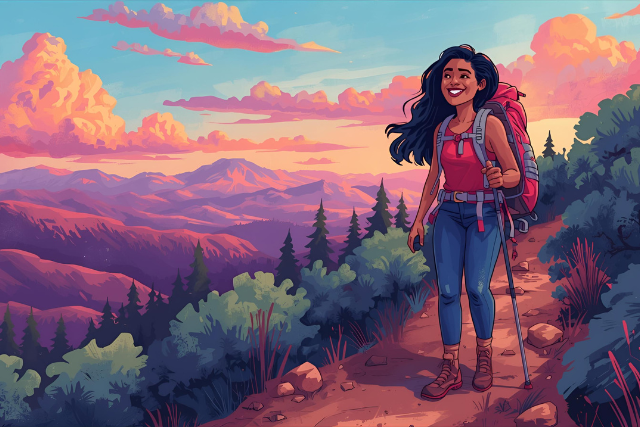
And if you need me, I’ll be training for my next big adventure: walking the Camino trail in Portugal next summer—a pilgrimage powered entirely by my own two feet, my own heart, and absolutely no plus-one required.

About Andrea Tessier
Andrea Tessier is a master life coach and Level 2 Internal Family Systems (IFS) Practitioner who helps ambitious, growth-oriented women build self-trust, release perfectionism, and step into authentic leadership. With over six years of experience blending psychology and spirituality, she guides clients to reconnect with their true Self and live with clarity, peace, and wholeness. Download her free Self Trust Starter Kit.

